Tear Duct Surgery
Watery Eye and Blocked Tear Duct Treatment
A constantly watering eye can be more than a nuisance. It can blur your vision, irritate the skin and lead to recurrent stickiness or infection.
Watery eyes have several possible causes, so the first step is always an accurate diagnosis. The right treatment depends on exactly what is causing the problem.
Dr Hannah Timlin is a consultant ophthalmic and oculoplastic surgeon with particular specialist expertise in tear duct surgery and lacrimal drainage disorders. She offers expert diagnosis and treatment of watery eyes and blocked tear ducts in London, including complex and revision surgery.
Consultant at Moorfields Eye Hospital · GMC 6134773 · Fellowship-trained lacrimal surgeon

At a glance
A quick summary of what causes watery eyes, how blocked tear ducts are treated and what to expect.
What causes a watery eye?
A watery eye, known medically as epiphora, happens when the eye produces more tears than it can clear away, or when tears cannot drain properly. Both can leave tears spilling onto the cheek.
There are several possible causes, and they need quite different treatment:
- Tear duct narrowing or blockage. If the tear drainage channels become narrowed or blocked, tears have nowhere to go and overflow.
- Eyelid position problems. If the eyelid turns outwards, sits loosely or no longer meets the eye correctly, the natural tear pump fails and tears are not drawn into the drainage system.
- Dry eye and reflex tearing. A dry or irritated eye surface can trigger bursts of reflex watering. The eye waters because it is dry, which is why drainage surgery is not the answer in these cases.
- Inflammation or infection. Inflammation of the eyelids, eye surface or tear sac, and infections such as conjunctivitis, can all cause watering.
- Age-related changes. The drainage system and eyelids change with age, which is why watery eyes become more common over time.
Because the causes are so different, accurate diagnosis matters. Treatment that helps one cause can be unhelpful, or even make things worse, for another. The aim of your consultation is to identify exactly why your eye is watering before recommending any treatment.
How tears drain
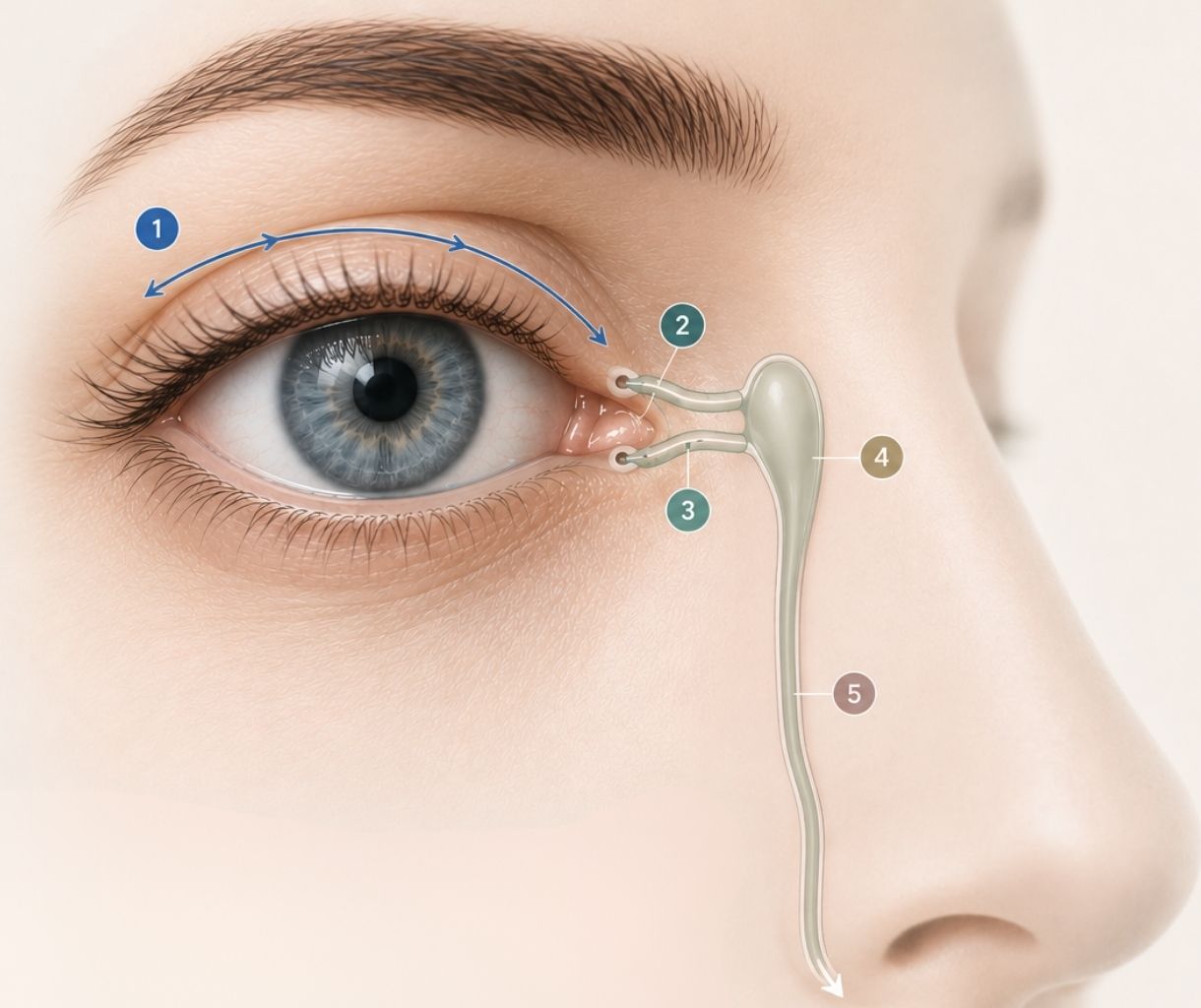
Understanding how tears drain helps explain why an eye waters. With each blink, tears spread across the surface of the eye and flow towards the inner corner, where they begin their journey into the nose:
- 1 Across the eye With each blink, tears are spread evenly across the surface of the eye.
- 2 Puncta Tears collect at the inner corner and drain through tiny openings called puncta.
- 3 Canaliculi From the puncta, tears pass through narrow channels called canaliculi.
- 4 Lacrimal sac Tears drain into the lacrimal sac, a small reservoir that sits beside the nose.
- 5 Nasolacrimal duct Tears flow down the nasolacrimal duct and empty into the nose. This is why a good cry can leave you with a runny nose.
Specialist expertise in tear duct surgery
Tear duct surgery and lacrimal drainage disorders are one of Dr Timlin's core areas of expertise. She is a fellowship-trained lacrimal surgeon, and her research in this field has been recognised with national and international awards. She also teaches tear duct and eyelid surgery to other surgeons as Module Lead for Adnexal Surgery on the UCL Ophthalmology MSc.
She manages the full range of tear duct problems, from straightforward blockages to complex and revision cases, including patients whose watering has returned after previous surgery elsewhere.
This focus sits within a broader oculoplastic practice. Dr Timlin is an experienced consultant who also performs blepharoplasty, ptosis (droopy eyelid) surgery, eyelid surgery and periocular reconstruction. That breadth matters here, because watery eyes are not always a tear duct problem. The tear film, the eyelids and the drainage system all work together, and an oculoplastic eye surgeon is well placed to recognise which of them is the true cause and to treat the eyelids and drainage system in the same plan when needed.

Treatments for watery eyes and blocked tear ducts
Because watery eyes have several causes, there is no single treatment. The right option is the one that addresses the underlying problem, and it may not involve surgery at all.
Treating the cause without surgery
When watering is caused by dry eye, surface irritation, inflammation or infection, treating that cause is usually the first step. Measures such as lubricants, lid hygiene or treating an infection can settle reflex tearing without an operation.
Correcting the eyelids
If a watery eye is caused by an eyelid that turns outwards, sits loosely or no longer meets the eye properly, the most effective treatment is to correct the eyelid position rather than the tear duct. Restoring the eyelid allows the natural tear pump to work again.
Opening a narrowed punctum (punctoplasty)
If the drainage opening at the inner eyelid has become too narrow, a small procedure called punctoplasty can open it to allow tears to drain. This is often a minor procedure under local anaesthetic.
Tear duct surgery (DCR)
When the tear duct itself is blocked, the main treatment is dacryocystorhinostomy, usually shortened to DCR. This creates a new drainage channel between the tear sac and the inside of the nose, bypassing the blockage so that tears can drain again. A soft, temporary tube is often placed for a short period to keep the new pathway open while it heals.
DCR can be performed in two main ways. Endoscopic (endonasal) DCR is carried out through the nose with no skin incision, so there is no visible scar. External DCR is performed through a small, carefully placed incision beside the nose that usually fades to become very discreet. Dr Timlin will discuss which approach is most suitable for you and why.
Bypass tube (Lester Jones tube)
If the drainage channels are completely blocked close to the eyelids, a small bypass tube, known as a Lester Jones tube, can be used to create a new route for tears. This is a more specialised procedure used in selected cases.
Complex and revision surgery
Some patients continue to have a watery eye after previous tear duct surgery, or have anatomy that makes treatment more challenging. These cases benefit from careful reassessment to understand why symptoms have persisted. Complex and revision tear duct surgery is an area of particular interest for Dr Timlin.
Will I need surgery?
Not every watery eye needs an operation. Many people are reassured to learn that their watering can be improved by treating the eye surface, managing an infection or correcting an eyelid problem.
Surgery such as DCR is recommended when there is a genuine blockage in the tear drainage system, or when the watering is troublesome enough to affect comfort, vision or daily life and simpler measures are unlikely to help.
During your consultation, Dr Timlin will examine your eyelids, eye surface and tear drainage, establish the cause of your watering and explain whether treatment is likely to help. The aim is to recommend the right treatment for your particular cause, not surgery for its own sake. In some cases, the most honest advice is that no treatment is needed.
Tired of a constantly watering eye? A specialist assessment will identify the cause, with no pressure to proceed.
Book a ConsultationYour consultation
Your consultation begins with a discussion of your symptoms, such as how long your eye has been watering, whether it affects one or both eyes, and whether you have any stickiness, discharge or recurrent infections.
Dr Timlin will examine your eyelids, eye surface and tear drainage system. This may include gently checking how the tear ducts drain, assessing your eyelid position and looking at the health of the eye surface. Where helpful, further tests or imaging of the tear ducts can be arranged to pinpoint the level of any blockage.
She will then explain what she has found, what is causing your watery eye, and the options available, including the likely benefits, limitations, risks, recovery and fees, so you can make an informed decision.

Recovery after tear duct surgery
Tear duct surgery is usually performed as day-case surgery, so most patients go home the same day. Recovery depends on the procedure. Minor procedures such as punctoplasty settle quickly, while DCR involves a little more healing.
After DCR it is common to have some bruising, mild swelling and a blocked or blood-tinged nose for a short period. You will be advised to avoid blowing your nose and to take things gently for a little while. Endoscopic DCR leaves no skin scar, and the small incision used in external DCR usually fades well.
Many patients return to desk-based work within around one to two weeks. If a temporary tube has been placed, it is removed at a simple follow-up appointment once healing is underway. You will be given clear aftercare advice covering nasal care, activity, eye drops and what to expect as you heal.
Risks and realistic expectations
Tear duct surgery such as DCR is well established and has high success rates in carefully selected patients, with most people experiencing a substantial improvement in their watering. As with any procedure, however, results cannot be guaranteed.
Common temporary effects include bruising, swelling, a blocked or blood-tinged nose and mild discomfort. Less common risks include bleeding, infection, irritation from a temporary tube, scarring with the external approach, and persistent or recurrent watering.
A small number of patients find that watering returns or does not fully settle, and may benefit from revision surgery. Dr Timlin will explain what surgery can realistically achieve for your particular cause, which risks are most relevant to you, and what the likely outcome is, so that your expectations are clear before going ahead.
Fees and insurance
Treatment for watery eyes and blocked tear ducts is usually functional rather than cosmetic, because it addresses a medical problem with tear drainage. For this reason it is often eligible for cover by private medical insurance, subject to your policy and your insurer's criteria.
Self-pay treatment is also available. As a guide, endoscopic DCR typically ranges from £4,000 to £7,500. The exact fee depends on the procedure recommended, the type of anaesthetic used, hospital fees and whether more than one issue needs to be treated, for example correcting the eyelids as well as the tear duct. Full guide prices are published on the patient information page.
After your consultation, you will receive a personalised treatment plan and quotation explaining the recommended procedure, the expected costs and what is included.
Tear duct treatment is often covered by private medical insurance. Fee guidance for self-paying patients is available when you book.
Book a ConsultationWatery eye and tear duct FAQs
A watery eye can be caused by a blocked or narrowed tear duct, an eyelid that sits in the wrong position, dry eye or surface irritation triggering reflex tearing, inflammation, infection or age-related changes. Because the causes are different, accurate diagnosis is needed before treatment.
Tears normally drain from the eye through small openings called puncta, along the tear duct system and into the nose. If this pathway becomes narrowed or blocked, tears cannot drain away and overflow onto the cheek, which can also lead to stickiness or recurrent infection.
DCR is the main operation for a blocked tear duct. It creates a new drainage channel between the tear sac and the inside of the nose, bypassing the blockage. It can be performed endoscopically through the nose, with no skin incision, or externally through a small, well-hidden incision beside the nose.
Endoscopic DCR is performed through the nose and leaves no skin scar. External DCR uses a small incision beside the nose that usually fades to become very discreet. The most suitable approach depends on your anatomy and the cause of the blockage.
Tear duct surgery such as DCR has high success rates in carefully selected patients, but no operation can guarantee a perfect result. A small number of patients have persistent or recurrent watering and may benefit from revision surgery.
Yes, in many cases. If watering is caused by dry eye, surface irritation, inflammation or infection, treating that cause can settle the symptoms without an operation. Surgery is recommended when there is a drainage blockage or an eyelid problem that needs correcting.
This is common. When the eye surface is dry or irritated, it can trigger bursts of reflex tearing. The watering is a symptom of the underlying dryness, so treating the surface, rather than the drainage system, is usually the right approach.
Yes. Dr Timlin has a particular interest in complex and revision tear duct surgery, including patients whose watering has returned after a previous operation. Assessment focuses on identifying why the previous surgery did not resolve the problem before planning further treatment.
Treatment for watery eyes and blocked tear ducts is usually functional rather than cosmetic, so it is often eligible for cover by private medical insurance. Self-pay treatment is also available, with a personalised quotation provided after your consultation.
No referral is needed for self-pay consultations; you can book directly. If you hope to use private medical insurance, your insurer may require a referral and supporting information before approving cover.
Book a Consultation
If you have a watery eye or a blocked tear duct, a specialist consultation can identify exactly what is causing it and which treatment is most appropriate for you.
Dr Hannah Timlin will assess your eyelids, eye surface and tear drainage before advising on the right approach, whether that is reassurance, simple measures or tear duct surgery.
Reviewed by Dr Hannah Timlin, Consultant Ophthalmic and Oculoplastic Surgeon (GMC 6134773). For general information only, not medical advice.